Guides · For office managers and the front desk
Six one-page guides to the calls your office misses.
Each one is a check you can run this week with what you already have: a phone, a call log, a clock.
Every figure on these pages is either an example, labelled as one, or a number you supply. When you have your own counts, put them in the calculator; it runs in your browser.
Guide 1 of 6 · Worked example
What a missed call costs your office
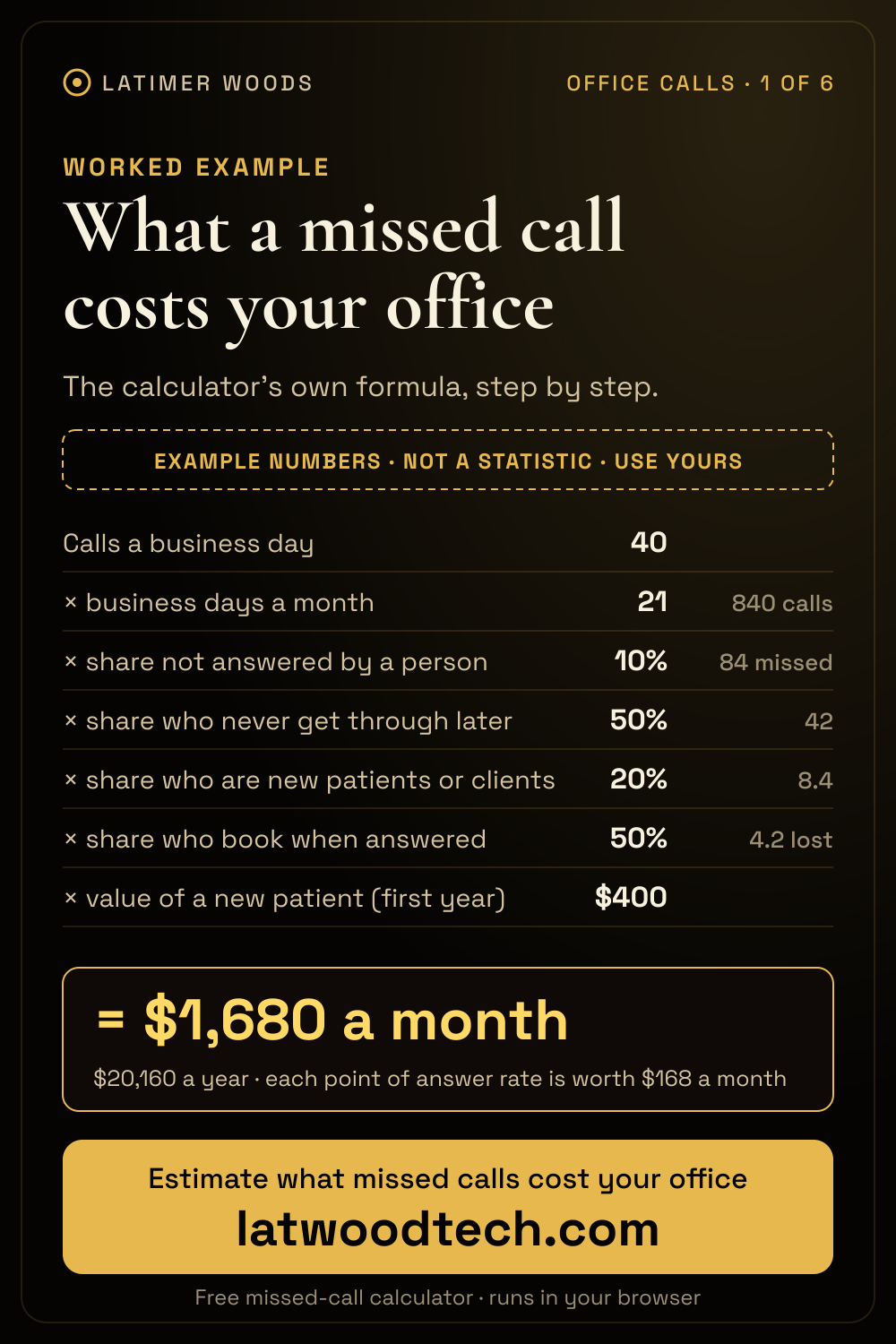
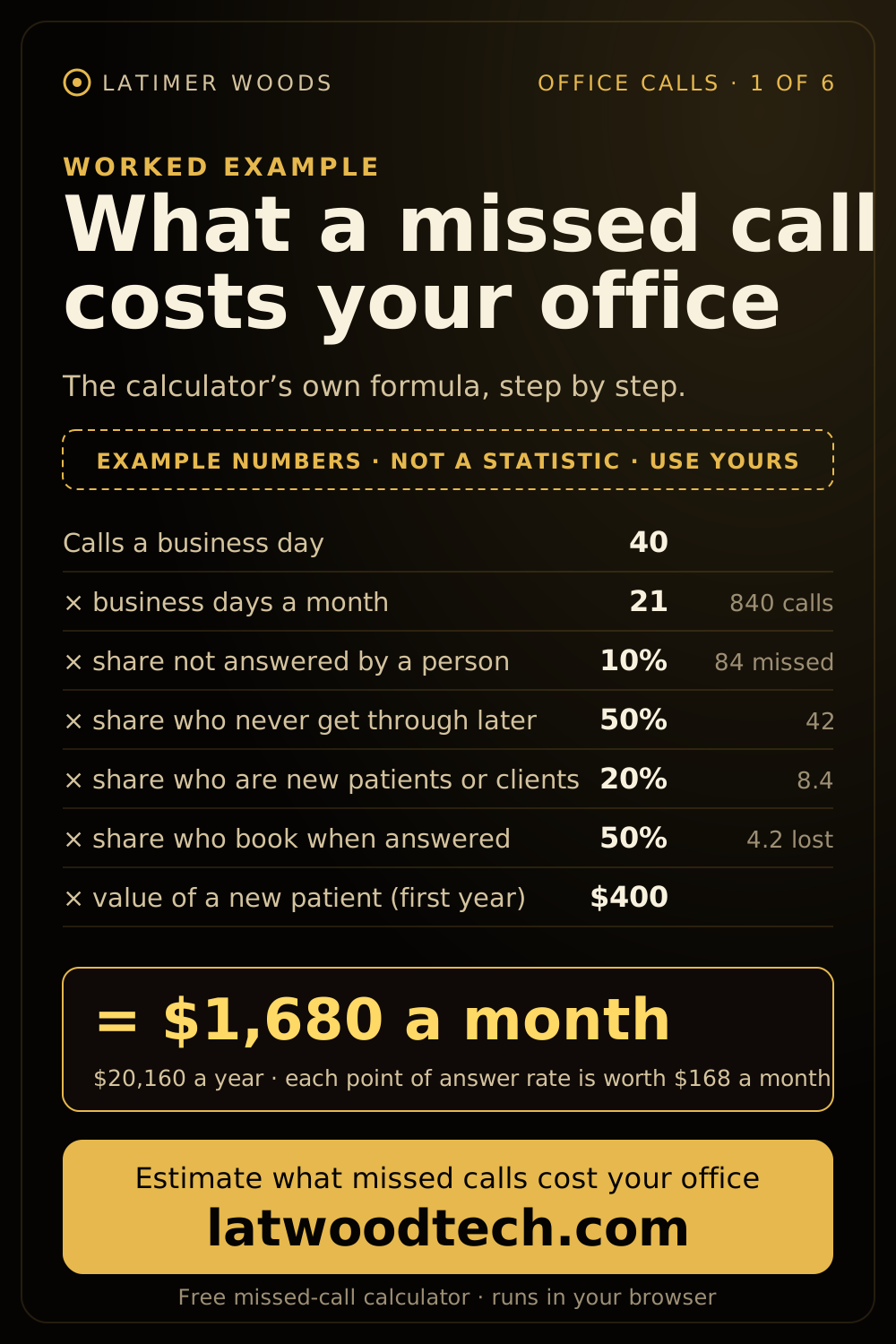
This is the calculator's own formula, worked with example numbers. They are not a statistic; replace each one with yours.
- 40 calls a business day × 21 business days = 840 calls a month.
- × 10% not answered by a person = 84 missed.
- × 50% who never get through later = 42.
- × 20% who are new patients or clients × 50% who book when answered = 4.2 new patients lost.
- × $400, the value of a new patient in the first year = $1,680 a month, or $20,160 a year.
In this example, each point of answer rate is worth $168 a month.
Guide 2 of 6 · Monday checklist
A 5-minute missed-call audit you can run on Monday
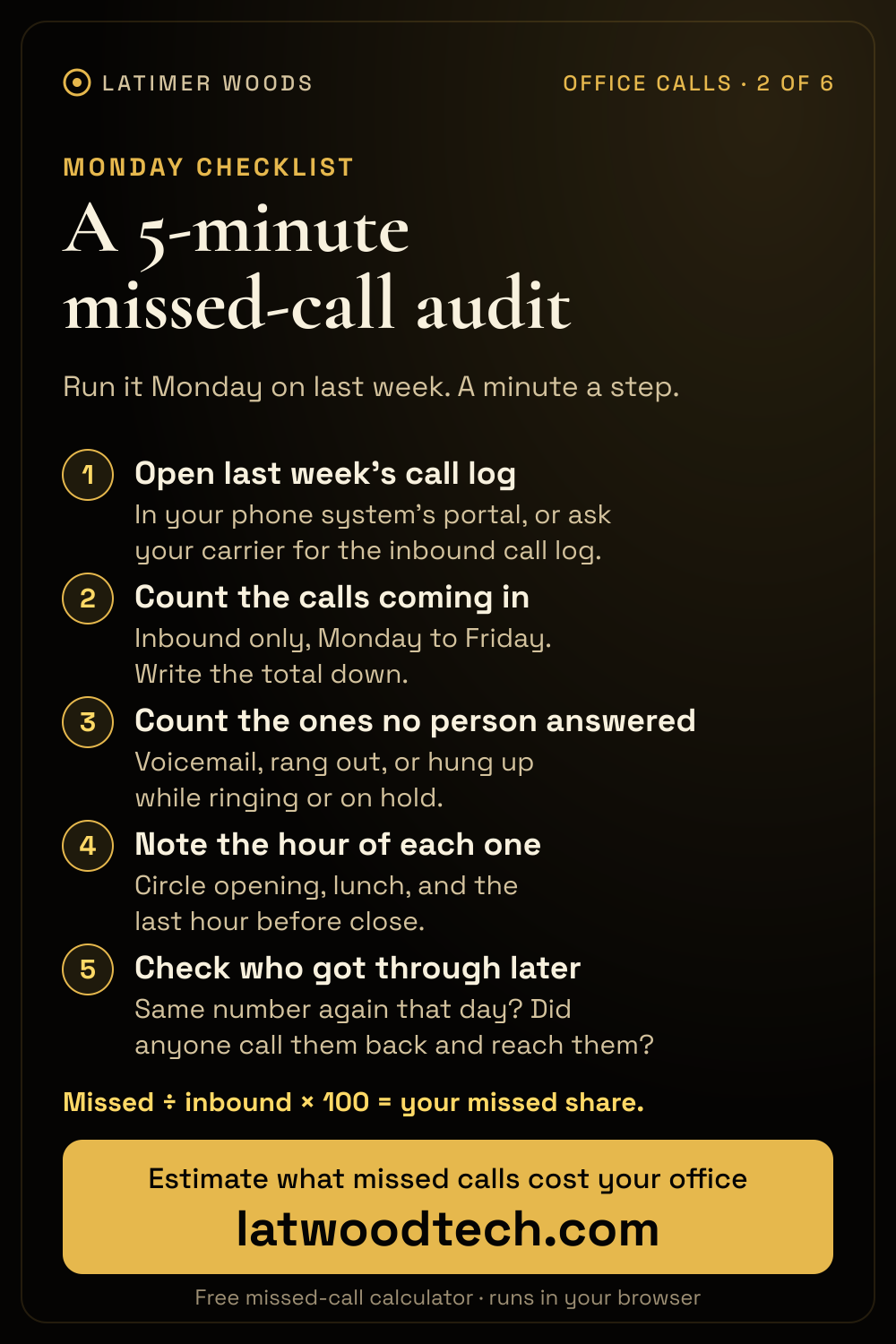
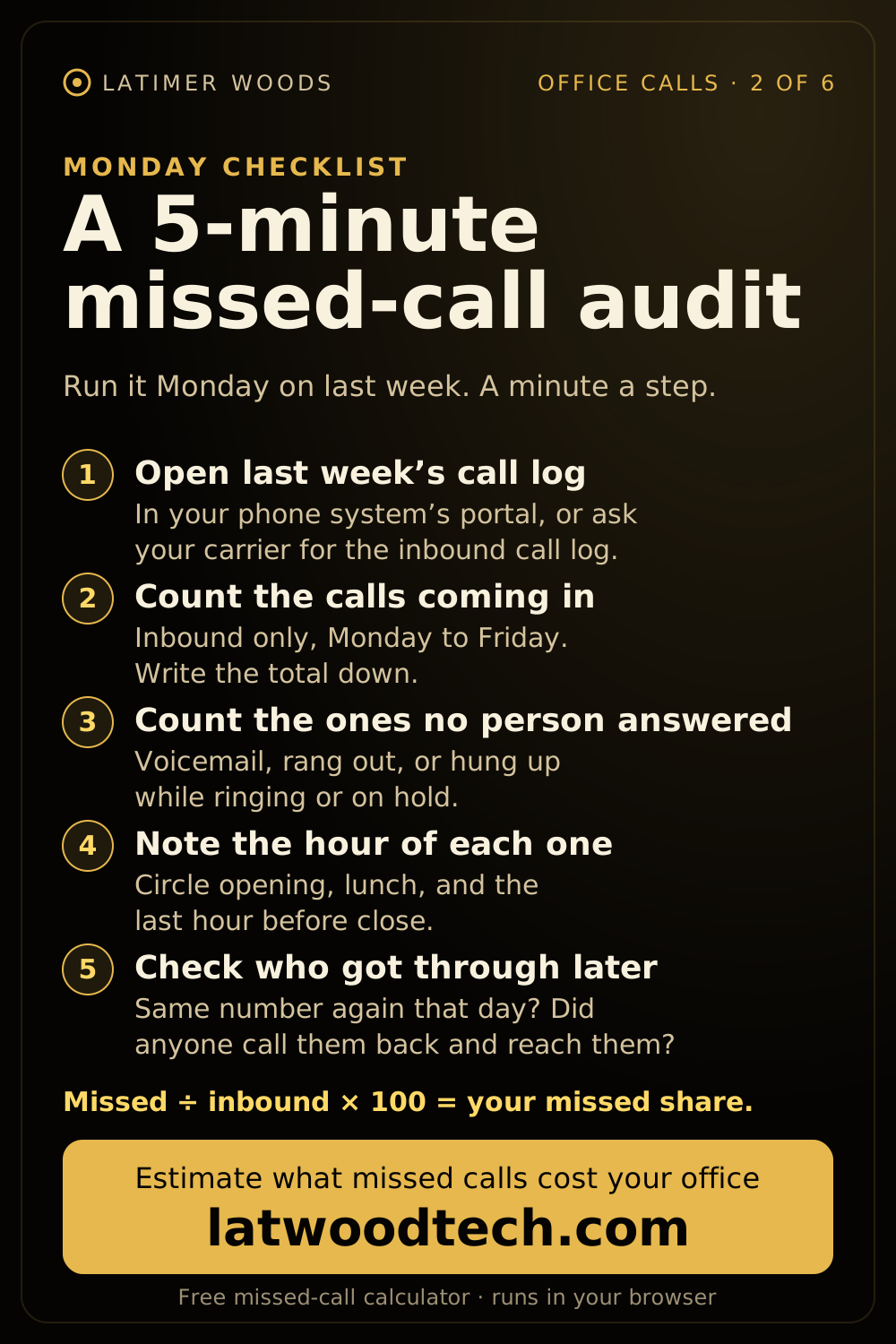
Run it Monday on last week's records, about a minute a step.
- Open last week's call log, in your phone system's portal, or ask your carrier for the inbound call log.
- Count the calls coming in: inbound only, Monday to Friday. Write the total down.
- Count the ones no person answered: voicemail, rang out, or hung up while ringing or on hold.
- Note the hour of each one. Circle opening, lunch, and the last hour before close.
- Check who got through later. The same number again that day? Did anyone call them back and reach them?
Missed ÷ inbound × 100 is your missed share, the third figure the calculator asks for.
Guide 3 of 6 · When the desk is empty
The lunch-hour and after-hours gap
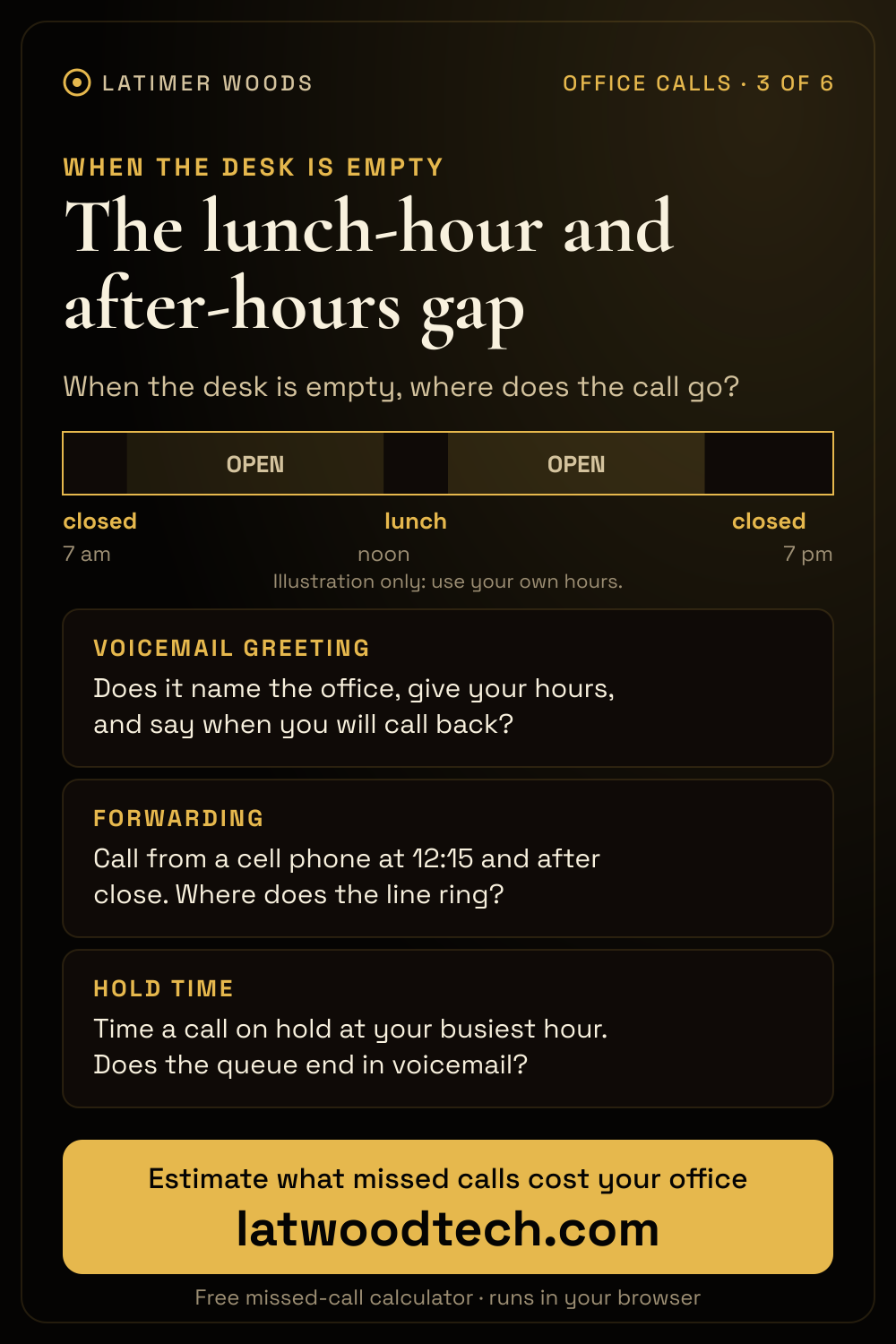
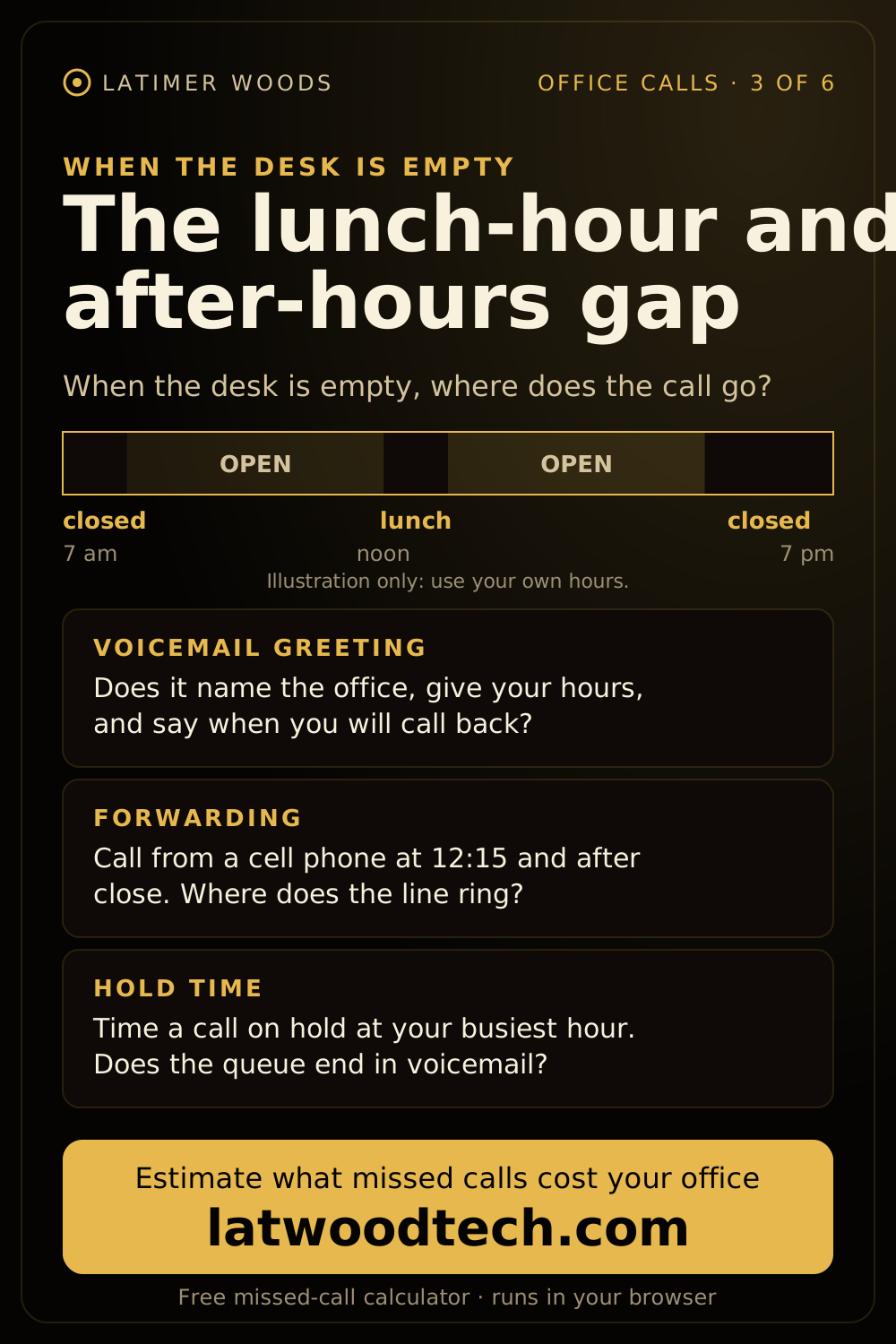
When the desk is empty, where does the call go? The day in the picture is an illustration; use your own hours.
- Voicemail greeting. Does it name the office, give your hours, and say when you will call back?
- Forwarding. Call from a cell phone at 12:15 and again after close. Where does the line ring?
- Hold time. Time a call on hold at your busiest hour. Does the queue end in voicemail?
Guide 4 of 6 · Front desk
A front-desk call-flow checklist
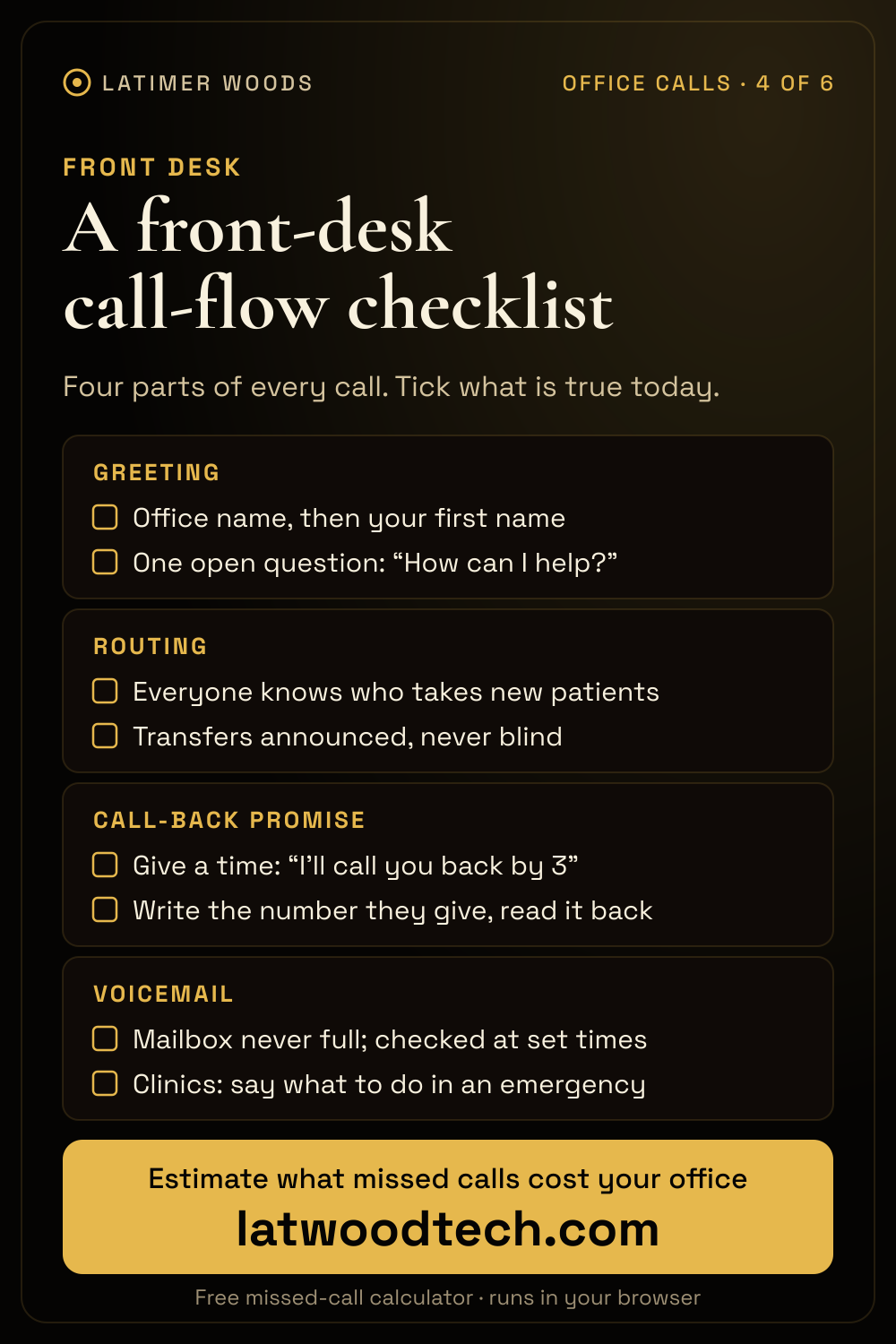
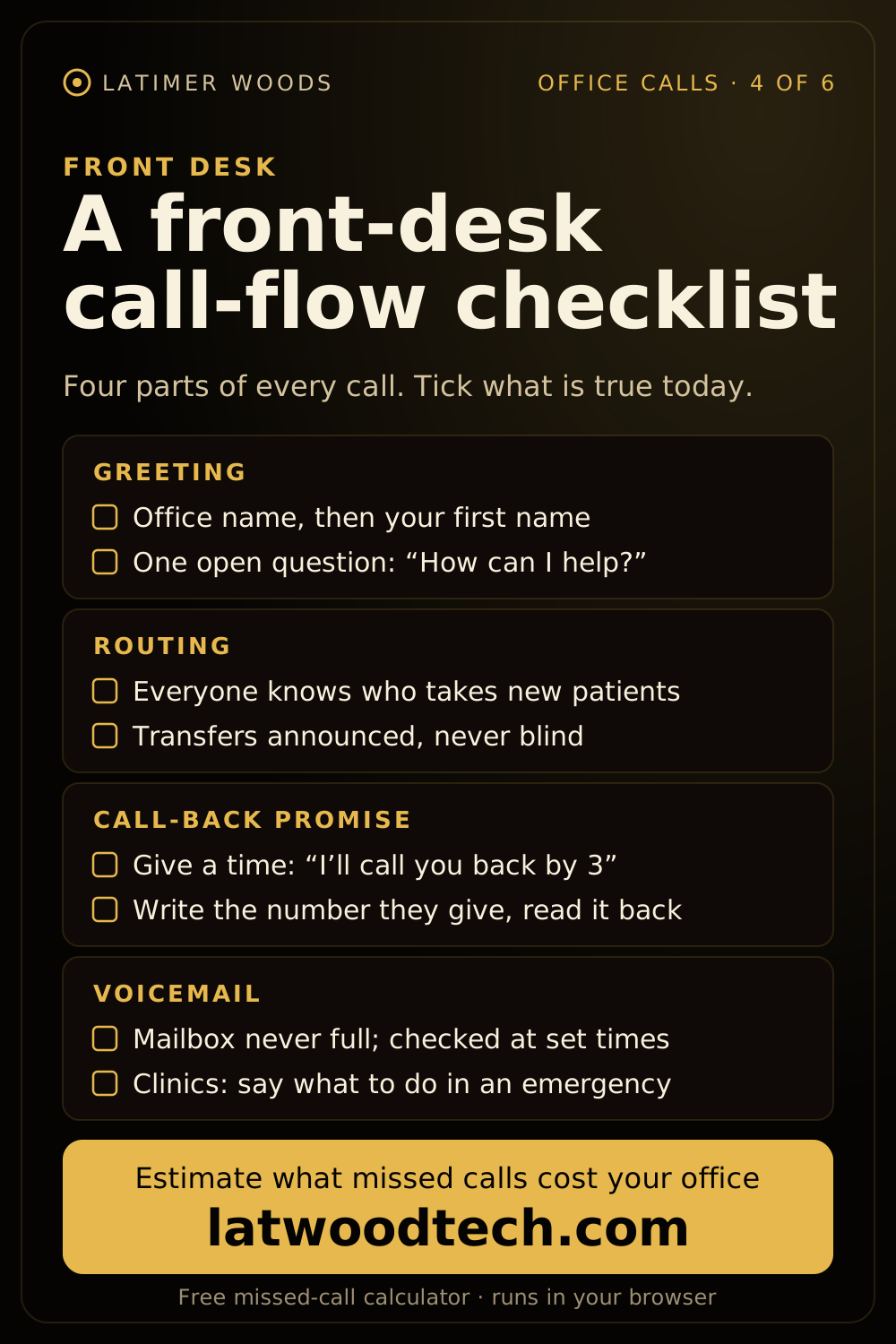
Four parts of every call. Tick what is true today.
- Greeting: office name, then your first name. One open question: "How can I help?"
- Routing: everyone knows who takes new patients. Transfers are announced, never blind.
- Call-back promise: give a time, such as "I'll call you back by 3." Write down the number the caller gives you and read it back.
- Voicemail: the mailbox is never full and is checked at set times. Clinics: the greeting says what to do in an emergency.
Guide 5 of 6 · Test call
When nobody answers, what does a caller get?
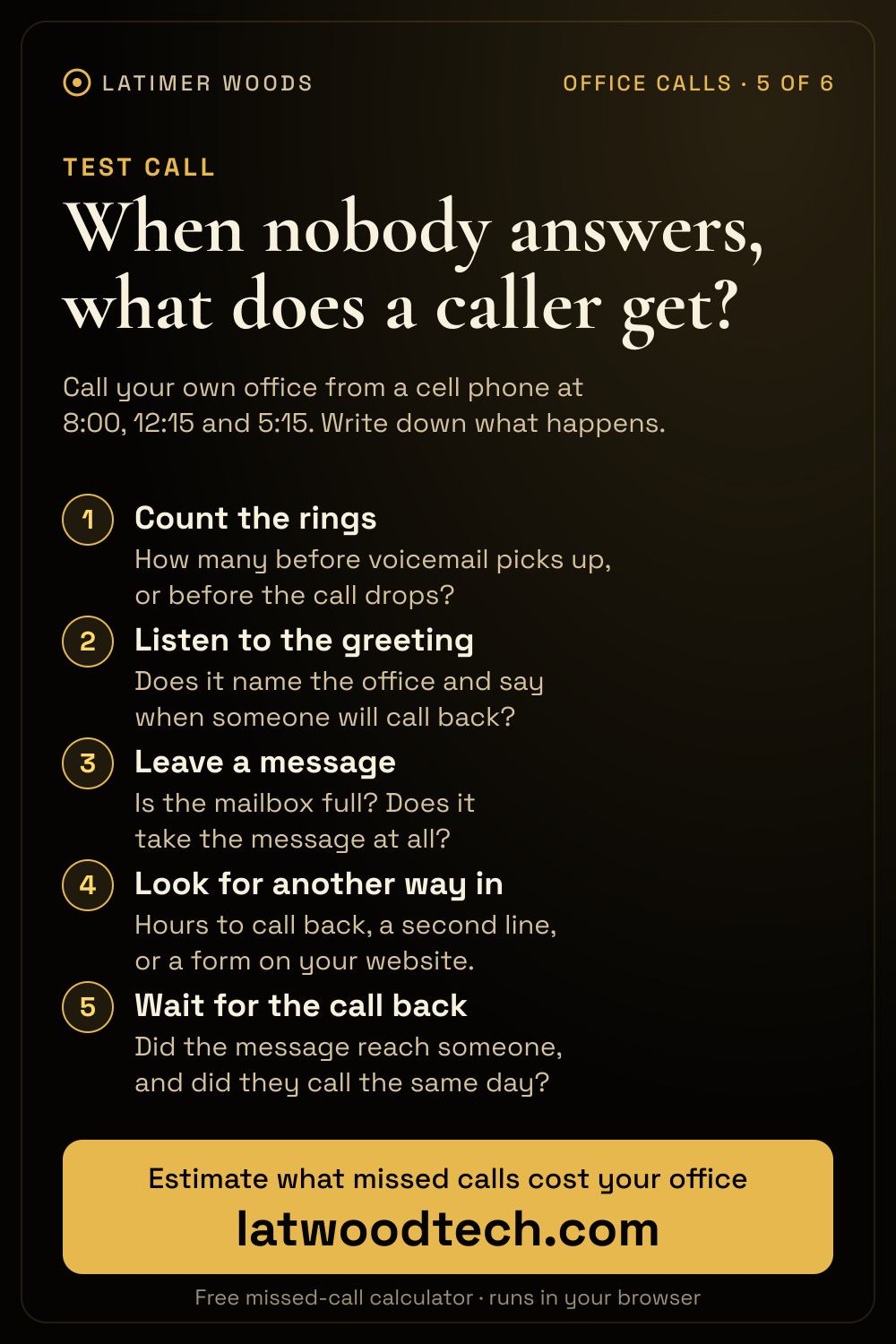
Call your own office from a cell phone at 8:00, 12:15 and 5:15. Write down what happens.
- Count the rings before voicemail picks up, or before the call drops.
- Listen to the greeting. Does it name the office and say when someone will call back?
- Leave a message. Is the mailbox full? Does it take the message at all?
- Look for another way in: hours to call back, a second line, or a form on your website.
- Wait for the call back. Did the message reach someone, and did they call the same day?
Guide 6 of 6 · Read the records
How to find missed calls in your phone bill or call log
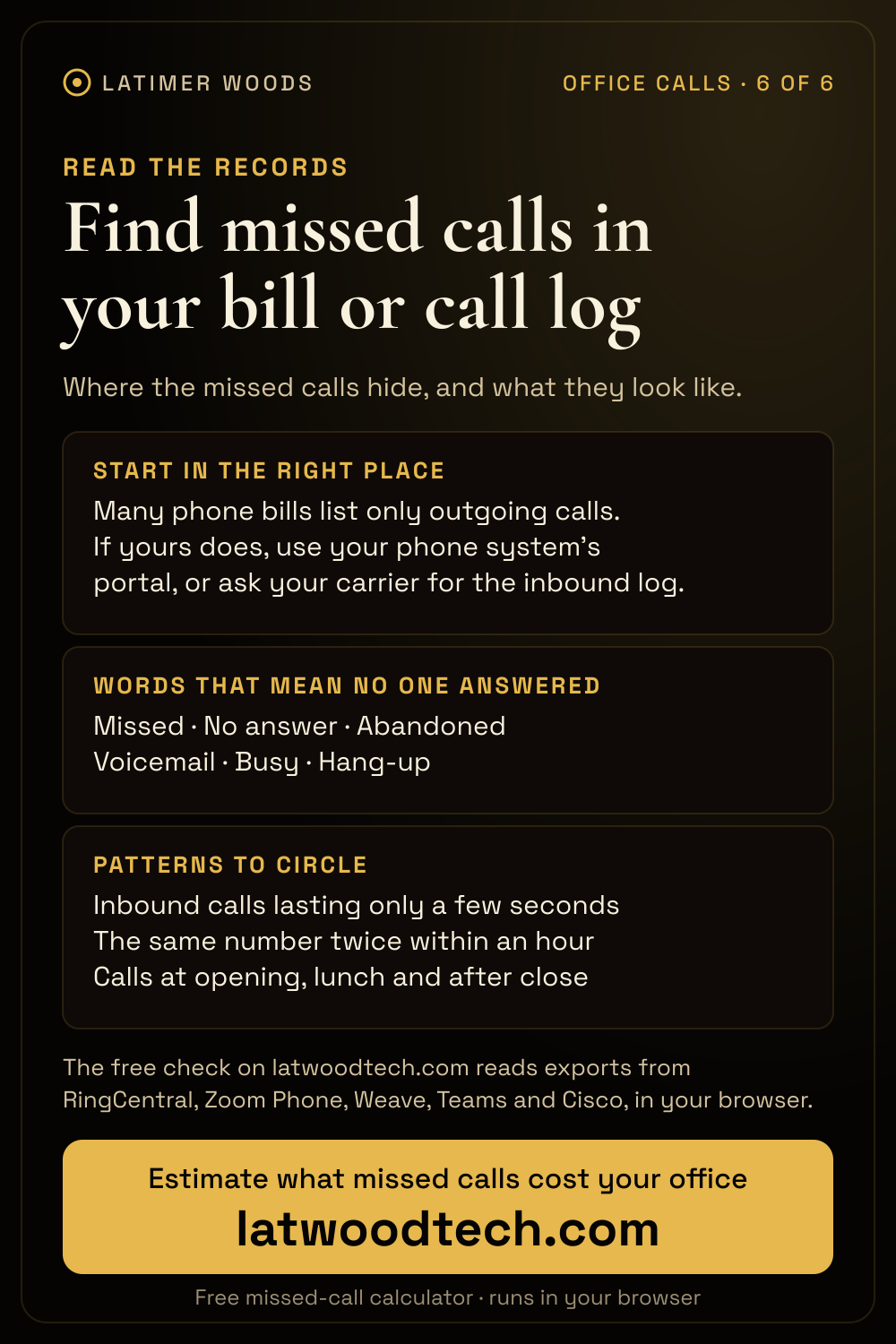
- Start in the right place. Many phone bills list only outgoing calls. If yours does, use your phone system's online portal, or ask your carrier for the inbound call log.
- Words that mean no one answered: missed, no answer, abandoned, voicemail, busy, hang-up.
- Patterns to circle: inbound calls lasting only a few seconds; the same number twice within an hour; calls at opening, lunch and after close.
The free check reads exports from RingCentral, Zoom Phone, Weave, Microsoft Teams and Cisco. The file is read in your browser and is never uploaded.